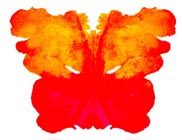
What do u see ?
Look up at the clouds drifting by. Or see the shadows on the moon. Each one of us might end up with a different perception of what we saw. This same technique is adopted by Projective Tests.
Projective Tests “Psychological diagnostic tests in which the test material is unstructured so that any response will reflect a projection of some aspect of the subject's underlying personality and psychopathology”
Projection enables the psychologist to gain a better idea about the unconscious mind. The unstructured stimuli maybe of various different forms. A picture, an inkblot, a dialogue – the interpretation of these clues gives access to our unconscious mind. This relatively unstructured task permits an almost unlimited variety of possible responses. Each response can then be analyzed and a basic idea of the individuals psyche maybe gained.
Rorschach Inkblot test is one such projective test. Named after
Hermann Rorschach this test consists of a set of 10 inkblots. The patient is asked to look at each blot and to say what it looks like or what it could be. Because the stimulus is ambiguous, the patient must impose his or her own structure. In doing so, thoughts, feelings, and themes, some of which are unconscious, are projected into the material.
Projective tests tend to have lower validity and reliability than objective tests. That is, they are less stable, and have lower relationships with other criteria. However, the information which they provide tends to be richer and more varied. The tests are still under lot of controversy. A proper structure to their interpretation was given by
John E. Exner.
Each interpretation of the inkblot is judged on the basis of –
1. Location--where is the thing that is seen?
2. Determinants--what makes it look like that? Form? Movement?
3. Form Quality -- how well does the thing seen fit what the blot looks like?
4. Contents and Populars -- what is it that is seen?
5. Organizational Activity-- are elements seen organized with respect to one another?
Ex: "An animal walking across a creek" "Fire coming out of a rocket"
6. What strange things did the taker say during the response?
7. What special content is there in the response?
More detail on -
individual response interpretation .
Interested in finding out what your unconscious mind projects ? Try the inkblot test on
Emode.
Rorschach Inkblots cannot be re-published. Only psychologists have access to these inkblots. But an interpretation of similar re-productions and how a psychologist scores them are given
here. A disclaimer to this site suggests that once you read thru their information it might not be ethical to take a Rorschach Test with a psychologist as the expected responses are discussed. Its worth a read-thru !
More information on Rorschach Inkblots @
Psychoheresy,
Phil.gu.se and
Skepdic.com.
